
The professional Counter-Strike landscape has evolved dramatically since the transition to Counter-Strike 2, bringing fundamental changes to how teams compete at the highest level. The cs2 tournament ecosystem now encompasses multiple championship formats, from Valve-sanctioned Majors with $1,250,000 prize pools to regional qualifiers that determine roster eligibility. Understanding this complex structure matters for anyone following professional esports in 2026, whether tracking team performance across the IEM Cologne Major or analyzing how the new MR12 regulation impacts tactical approaches. The abolition of franchise-exclusive leagues has reopened pathways for emerging organizations, while updated gameplay mechanics have forced veteran squads to adapt strategies refined over years of CS:GO competition. These structural and tactical changes have also significantly boosted the CS betting market, where modern platforms like 1 king offer fans deep betting markets, high odds, and new opportunities for esports predictions.
Introduction: What is CS2 and an Overview of Major Championships and Tournaments
Counter-Strike 2 represents Valve’s complete rebuild of the legendary tactical shooter using the Source 2 engine. Released in September 2023 as a replacement for Counter-Strike: Global Offensive, CS2 introduced volumetric smoke grenades, improved netcode through sub-tick updates, and revamped visual rendering. The competitive infrastructure transitioned alongside the technical upgrade, maintaining the core tournament hierarchy while adjusting qualification pathways and match formats.
The championship calendar divides into three distinct tiers. Valve Majors remain the pinnacle, occurring three times annually with standardized prize distribution and Legend status implications. Premier tier events organized by ESL, BLAST, and PGL offer comparable prize pools but lack the qualification points that determine Major seeding. Regional competitions form the foundation, where teams accumulate circuit rankings necessary for Major qualification.
Geographic diversity defines the modern tournament landscape. The cs2 tournament 2026 calendar includes events across five continents, from the CS Asia Championships in Shanghai to IEM Atlanta. This distribution ensures regional representatives compete for global recognition while maintaining localized fanbases. Tournament operators coordinate schedules to prevent overlap between S-tier events, maximizing viewership and allowing top rosters to participate in multiple championships throughout the year.
Official CS2 Majors: The Most Prestigious Competitions by Valve
Valve-sponsored Majors maintain their position as the most significant competitions in professional Counter-Strike. The IEM Cologne Major 2026, held June 2-21 in Germany, exemplified this prestige with 32 participating teams and a $1,250,000 prize pool. Team Falcons secured first place, defeating FURIA in the grand final, while the event recorded viewership metrics that surpassed previous CS:GO championship peaks.
Major tournaments follow a strict three-stage format. The Challengers Stage features sixteen teams competing for eight advancement spots. The Legends Stage narrows the field from sixteen to eight through another round of eliminations. The Champions Stage presents a single-elimination bracket where the final eight teams compete for the title. This structure ensures that only consistently performing rosters reach the playoff rounds.
Qualification for Majors operates through the RMR system, detailed in subsequent sections. Teams earn their spots months before the main event, creating preparation periods where roster stability becomes crucial. Organizations that replace players after qualification risk forfeiting their seeds, a policy that has reduced mid-season transfers and strengthened team cohesion across competitive cycles.
Prize distribution at Majors follows Valve’s established model. The champion receives approximately 40% of the total prize pool, while last-place finishers in the Challengers Stage still earn compensation for participation. Additionally, teams receive a portion of revenue from in-game souvenir packages sold during Major broadcasts, tying community engagement directly to competitor earnings.
Intel Extreme Masters (IEM) Franchise in the Structure of Professional Esports
The Intel Extreme Masters series operates as the longest-running esports tournament brand, maintaining consistent CS2 championships across multiple continents. IEM Atlanta 2026, hosted May 11-17, featured sixteen teams competing for a $1,000,000 prize pool. Natus Vincere claimed first place over GamerLegion, demonstrating the competitive depth that defines IEM events.
ESL’s tournament infrastructure provides standardized competitive conditions across all IEM stops. Server specifications, peripheral equipment, and stage setups remain consistent whether events occur in Katowice, Cologne, or Sydney. This uniformity eliminates environmental variables that could advantage teams familiar with specific venue configurations, ensuring that tactical preparation and mechanical skill determine outcomes.
The IEM circuit contributes to the broader cs2 ongoing tournament ecosystem through its point-based ranking system. Teams accumulate ESL Pro Tour points based on placement at IEM events, with rankings determining invitations to subsequent championships. Organizations must balance participation in IEM competitions with other tournament commitments, as scheduling conflicts occasionally force difficult decisions about event prioritization.
Broadcasting production at IEM events sets industry standards for esports presentation. Multi-language commentary streams, player-perspective cameras, and real-time statistical overlays provide viewers with comprehensive match analysis. The integration of in-game director tools allows observers to highlight crucial moments as they unfold, capturing clutch plays and tactical executions that define championship-caliber Counter-Strike.
RMR (Regional Major Rankings) Qualification Model and Its Strict Criteria
The Regional Major Rankings system replaced the previous Major qualification structure in 2020 and continues under CS2 with refined criteria. RMR tournaments occur in six regions: Europe, Americas, Asia, China, Oceania, and Middle East/Africa. Each region receives a predetermined number of Major slots based on historical performance and player population.
Teams accumulate RMR points through multiple qualification events held in the months preceding each Major. The structure prevents single-tournament variance from determining Major participants, requiring sustained performance across at least two separate competitions. For the IEM Cologne Major 2026, regional qualifiers ran from March through May, with teams needing top-three finishes in their respective RMR tournaments to secure direct invitations.
Roster stability rules enforce strict requirements on team composition. Organizations must maintain at least three players from their qualifying lineup through the Major itself. Transfers or replacements trigger point penalties or complete disqualification depending on timing and circumstances. This policy emerged after controversial roster moves in earlier competitive cycles.
The RMR model democratized Major access compared to previous invitation-based systems. Tier-two organizations can now earn championship berths through regional performance without requiring recognition from tournament organizers. This openness has introduced rosters like GamerLegion and Monte into Major competitions, teams that might have been overlooked under legacy qualification formats.
In-Game Economy and the New MR12 Match Regulations
Counter-Strike 2 introduced the MR12 format as the competitive standard, reducing regulation match length from thirty rounds to twenty-four. Teams now play twelve rounds per half instead of fifteen, reaching match point at thirteen round wins rather than sixteen. This adjustment shortened average game duration by approximately 20%, allowing tournament organizers to schedule more matches per broadcast day while maintaining competitive integrity.
The economy system received corresponding adjustments to compensate for reduced round counts.
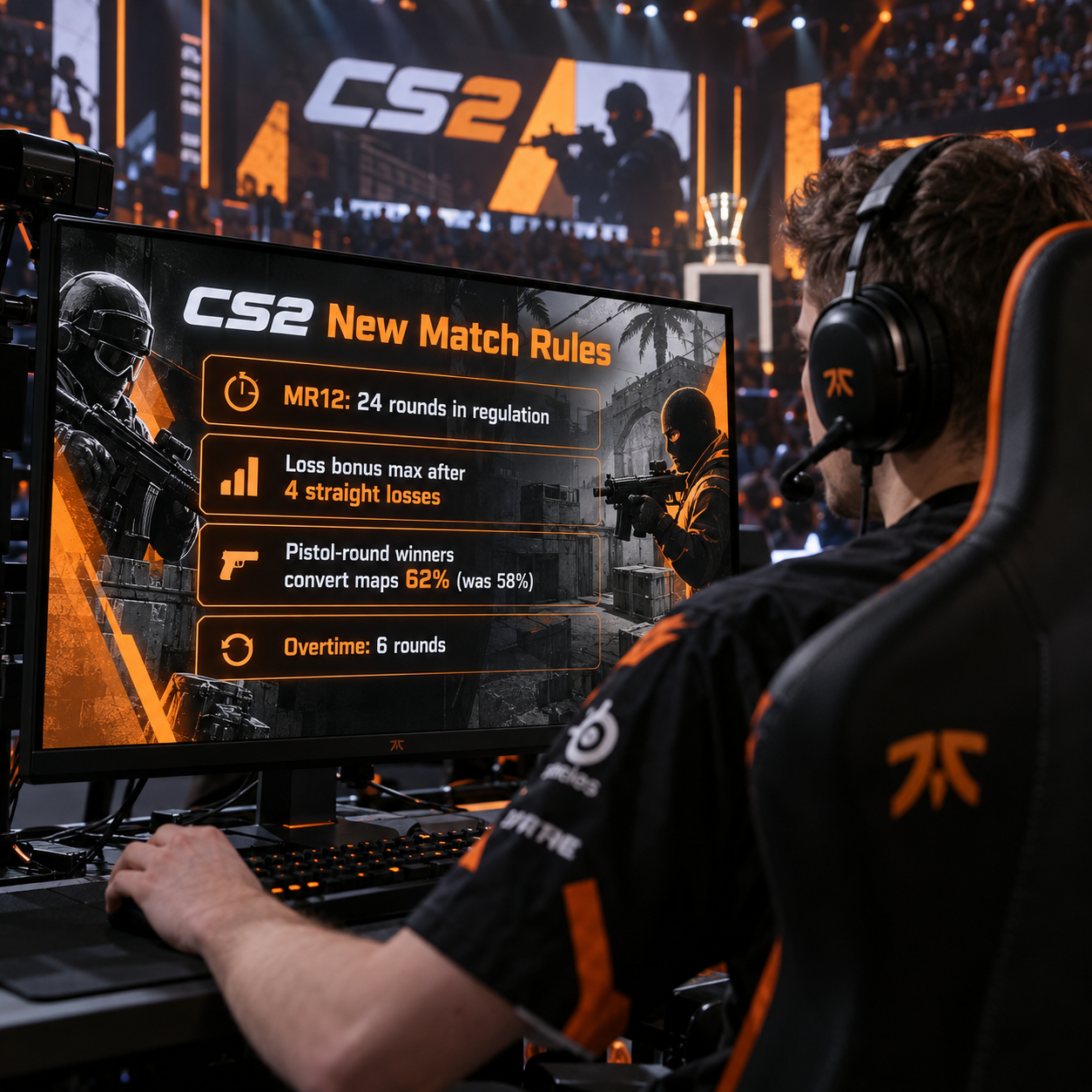
Loss bonus accumulation accelerated, reaching maximum values after four consecutive losses instead of five. Weapon and utility prices remained largely unchanged, but the faster economic recovery means teams exit “eco rounds” more quickly. This compression intensifies the importance of pistol rounds and early-game momentum.
Tactical adaptation to MR12 has been significant across professional cs2 tournament play. Teams can no longer rely on slow economic grinding to overcome early deficits. Statistical analysis of the IEM Cologne Major 2026 revealed that teams winning the first pistol round secured overall map victories 62% of the time, compared to 58% under the previous MR15 format.
Overtime rules adjusted proportionally to MR12 implementation. Extra periods now consist of six rounds rather than the previous ten-round overtime structure.
First-to-four overtime victories replaced first-to-six, maintaining the same percentage threshold while reducing potential match extensions.
Abolition of Closed Franchise Leagues as a Step Towards Democratizing the Scene
The dissolution of the ESL Pro League’s partner team system marked a fundamental restructuring of Counter-Strike’s competitive ecosystem. Previously, twelve partnered organizations held permanent league positions, relegating non-partnered teams to qualification tournaments for remaining spots. This franchise model guaranteed revenue distribution and tournament access for select organizations regardless of current form.
Valve’s intervention in 2023 mandated open qualification pathways for all premier competitions. Tournament organizers could no longer reserve slots for specific teams based on organizational partnerships. The policy change emerged from community pressure and concerns that franchise systems limited competitive mobility, preventing skilled rosters without major organizational backing from accessing top-tier competition.
The impact became evident throughout the cs2 next tournament qualification cycles. Organizations like Legacy, which won the CS Asia Championships 2026, and teams competing in the FISSURE Playground #3 gained opportunities that would have been structurally impossible under franchise restrictions. The competitive field expanded as regional squads earned direct matchups against established international rosters.
Economic implications of franchise abolition created challenges for team sustainability. Organizations previously relied on guaranteed league revenue to fund player salaries and operational costs. The shift to merit-based qualification introduced financial uncertainty, particularly for teams experiencing temporary performance slumps. Some organizations responded by developing secondary rosters to maintain competitive presence across multiple qualification pathways.
New Gameplay Mechanics and Their Impact on Professional Matches
Counter-Strike 2’s transition to Source 2 introduced mechanical changes that fundamentally altered competitive interactions. Volumetric smoke grenades now behave as dynamic three-dimensional objects rather than static sprites. Bullets pass through smoke with realistic dispersion, while explosive damage displaces smoke particles temporarily. Professional players exploit these properties by creating sightlines through smoke with carefully placed grenades or gunfire.
Sub-tick update technology replaced the 64-tick and 128-tick server standards of the previous game. The system processes player inputs between standard tick intervals, theoretically eliminating discrepancies where actions occurred between server updates. Professional reaction times at the highest level mean that even millisecond improvements affect peek timing, spray control, and movement precision.
Graphical rendering updates changed how players gather information from visual cues. Enhanced lighting systems and physically-based materials improved model visibility in certain map areas while complicating identification in others. Teams spent months recalibrating positioning strategies on classic maps like Dust II and Inferno, where updated visuals altered common angle-holding positions.
Audio processing received significant revisions that affected information gathering. The HRTF spatial audio implementation provides more accurate directional sound, allowing players to pinpoint opponent locations with greater precision. Footstep audio clarity increased, making silent movement techniques even more valuable in competitive scenarios.
Championship Geography: Key Regions and Arenas of Top Tournament Operators
The global distribution of premier CS2 competitions reflects the game’s international playerbase and esports infrastructure maturation. Europe maintains the highest concentration of S-tier events, hosting approximately 40% of major championships. The Lanxess Arena in Cologne accommodated the IEM Cologne Major 2026 with capacity for 18,000 spectators, while the Spodek Arena in Katowice regularly serves as a tournament venue for ESL events.
Asia’s growing prominence in the competitive calendar manifests through dedicated regional championships. The CS Asia Championships 2026 in Shanghai offered a $1,000,000 prize pool, matching many premier European events. China’s separate competitive ecosystem, due to regulatory requirements, maintains parallel tournament structures that occasionally intersect with international competitions.
North American tournament infrastructure centers around major metropolitan venues. The State Farm Arena in Atlanta hosted IEM Atlanta 2026, providing facilities comparable to traditional sports championships. Regional tournaments function as proving grounds for rosters aspiring to qualify for RMR competitions and eventual Major participation.
Emerging regions continue developing competitive infrastructure through localized events. Middle Eastern esports investment has produced championship-caliber organizations like Team Falcons, which secured victories at both the CS Asia Championships 2026 and the IEM Cologne Major 2026. This geographic diversification strengthens the global competitive ecosystem by distributing talent development and viewership across multiple time zones and cultural markets.
FAQ
What is the prize pool for major CS2 tournament events in 2026?
The IEM Cologne Major 2026 featured a $1,250,000 prize pool, the largest for Counter-Strike championships. Other premier events like the CS Asia Championships and IEM Atlanta offered $1,000,000 each. Tier-two competitions typically range from $30,000 to $400,000 depending on the organizing body and regional significance.
How many teams participate in Valve-sponsored Major championships?
Valve Majors accommodate 32 teams divided across three stages. Sixteen teams begin in the Challengers Stage, with eight advancing to join eight pre-seeded teams in the Legends Stage. The final eight teams compete in the Champions Stage single-elimination bracket.
What are the requirements for teams to qualify for cs2 tournament Major events?
Teams must finish top-three in their regional RMR qualifier tournaments, maintaining at least three original players from the qualifying roster through the Major. Regional allocation varies by geographic zone, with Europe and Americas receiving the most slots. Qualification typically occurs two to three months before the main championship event.
How did the MR12 format change competitive Counter-Strike?
MR12 reduced regulation matches from thirty rounds to twenty-four, shortening average game length by 20%. The economy system accelerated to compensate, reaching maximum loss bonuses after four rounds instead of five. This compression increased the strategic importance of pistol rounds and reduced the viability of slow economic grinding strategies.
Which regions host the most prestigious CS2 championships?
Europe hosts approximately 40% of premier tournaments, including the IEM Cologne Major and various ESL Pro League events. Asia has expanded significantly, with major championships in Shanghai and Suzhou featuring million-dollar prize pools. North America maintains consistent tournament infrastructure through IEM events and regional leagues.
What impact did franchise league abolition have on the competitive scene?
The removal of permanent partner slots democratized tournament access, allowing teams to qualify purely through competitive performance. Organizations like Legacy and GamerLegion gained opportunities previously restricted by franchise partnerships. This change increased competitive mobility but introduced financial uncertainty for teams previously guaranteed league revenue.
How do RMR points determine Major qualification?
Teams accumulate points across multiple regional qualifier events held months before each Major. Point totals rank teams within their geographic region, with top performers earning direct Major invitations. The system requires sustained performance across at least two separate tournaments, preventing single-event variance from determining championship participation.